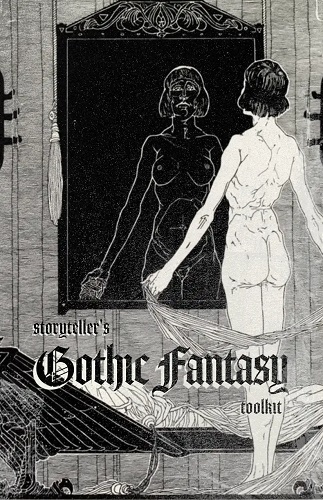
Storyteller’s Gothic Fantasy Toolkit
Systemless Sourcebook by Yoru Creative Studio
Storyteller’s Gothic Fantasy Toolkit
The portrait has hung in the same hallway for a hundred and forty years. She has walked past it every day of her life, and she has never once noticed that its eyes don’t match her father’s.
The Storyteller’s Gothic Fantasy Toolkit is a GM reference for campaigns that stay close to home: one house, one bloodline, one family that has spent generations not talking about something. The horror in this book has a surname. It sits at the dinner table, signs the will and hears confession on Sundays.
The book has no stat blocks and no spell lists. It covers the setting side of the work: the estate, the family, the dead who won’t rest and the living who would prefer they kept quiet. Everything is written in plain language, so it drops into whatever system your table already plays.
One idea runs through every chapter. In most genres, telling the truth releases the tension. In gothic fantasy it sets it off. The tools here are built around secrets that stack on top of each other and confessions that change everything, rarely for the better.
What’s inside
- The ancestral estate. Architecture laid down in layers, where every rushed renovation and sealed wing has a reason behind it. Hereditary curses with rules your players can trace, each with one way out that no generation has tried. Household staff who know more than the family. Tools for running the house as a presence with moods of its own.
- Forbidden knowledge. Obsession runs as a six-stage descent where every step seemed reasonable at the time. You settle in advance how much of a character’s distorted account is true, so the ambiguity stays honest. Forbidden texts, dangerous experiments, and a cost table for what understanding takes from the person who wanted it.
- Sixteen character archetypes (eight playable, eight NPC), each built on the gap between the face they show and what they are underneath. The last heir, the bride who knew too little, the servant who remembers everything, the matriarch who rules through grief.
- Twelve restless dead. A grandmother whose portrait has started watching people. A groom who still waits at the altar on the anniversary. A child who counts the stairs. Each is held here by a specific injustice, and laying them to rest means uncovering it.
- Twelve antagonists who call their control love. A patriarch, a priest who never quite breaks the seal of confession, a physician who diagnoses disobedience, an aunt with an unfinished will. Each entry covers their method, how they justify it to themselves, their weakness and what opposing them will cost.
- Twenty-two locations across ancestral houses, moorland, crypts and churchyards, and hidden architecture such as priest’s holes and servants’ corridors. Each has three truths for players who search patiently.
- Secrets and confession as a system you can run. Four layers of secret, a framework for building a confession scene, tables for how listeners react, the psychological and supernatural forms guilt takes, and the triggers that bring the past back.
- Twenty-five adventure seeds in five registers: family curse, forbidden knowledge, the restless dead, corrupted authority, and confession and guilt. Each gives you the surface situation, the hidden layer underneath, the decision it forces, and what happens if the characters stay out of it.
- Twenty-four random tables in d6, d12 and d20 for names, interior and exterior atmosphere, sensory details, NPCs, curses, secret fragments, estate rooms, rumours, complications and session zero.
- A quick-reference appendix with a pre-session checklist, a tone check, a family history sheet, a family tree, a secret tracker and a short reading list.
Rename the family, move the estate and rewrite the curse to fit your campaign. The book is a toolbox, and the house is yours to build with it.
System: System-agnostic
Format: PDF, 98 pages
Storyteller’s Gothic Fantasy Toolkit is available through DriveThruRPG in PDF.
Please note: The links in the post above are “affiliate links”. This means if you click on the link and purchase the item the author of this post will receive an affiliate commission.

