Welcome to 1985. Ronald Reagan begins his second term as US President, Whitney Houston releases her debut album and wins two Grammys as well as Billboards Album of the Year, British soap Eastenders airs on BBC for the first time, Mikhail Gorbachev becomes the Soviet leader, LiveAid takes place in Wembley Stadium, London and John F. Kennedy Stadium, Philadelphia. Super Mario Bros is released by Ninetendo, Microsoft Windows 1.0 is released, and Coca Cola release “New Coke” in April before backtracking and announcing the return of “Classic Coke” in June.
There were of course a load of movies released too. So, what were my top five from 1985? Glad you asked…
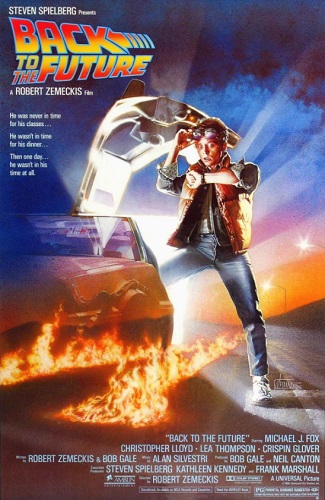
Let’s start with the cream of the bunch. Not only my favourite from 1985, but also the years highest grossing movie which catapulted Michael J. Fox to movie stardom and launched a fantastic and well loved franchise.
“Back to the Future,” directed by Robert Zemeckis, is a sci-fi adventure film that blends time travel, comedy, and thrilling escapades. The story centers around teenager Marty McFly (played by Michael J. Fox) and eccentric scientist Dr. Emmett “Doc” Brown (played by Christopher Lloyd) as they embark on a time-traveling journey.
Marty McFly is an ordinary high school student living in Hill Valley, California, in 1985. He befriends the eccentric Dr. Brown, who has created a time machine out of a DeLorean car, powered by plutonium. During a test run, a group of Libyan terrorists, seeking revenge on Doc Brown, interrupts the experiment, forcing Marty to escape in the DeLorean. In a dramatic sequence, Marty accidentally activates the time machine and travels back in time to the year 1955.
In 1955, Marty encounters younger versions of his parents, George McFly (played by Crispin Glover) and Lorraine Baines (played by Lea Thompson). Through a series of events, Marty inadvertently interferes with their initial meeting, jeopardizing his own existence by altering the course of his parents’ relationship.
Desperate to set things right and ensure his own existence, Marty seeks the help of the younger Doc Brown, who is initially skeptical but eventually assists Marty in devising a plan to get back to the future. Marty discovers that he has limited time to rectify the situation before being stranded in the past permanently.
Marty navigates the challenges of the 1950s, attempting to orchestrate events that will ensure his parents fall in love and ultimately lead to his birth, whilst also trying to avoid altering the timeline further, all while finding a way to harness the power of the DeLorean to return to 1985.
Marty ends up playing at the school dance in an attempt to get his parents together. Playing “Johnny B. Goode” to a stunnded crowd. His attempts work however, his parents’ relationship is rekindled ensuring his existence, and allowing him to return to the present.
As the film concludes, Marty returns to 1985, finding that his actions in the past have significantly improved his family’s situation. He reunites with Doc Brown, but their joy is short-lived as Doc reveals plans for another time-traveling adventure, setting the stage for the sequel.
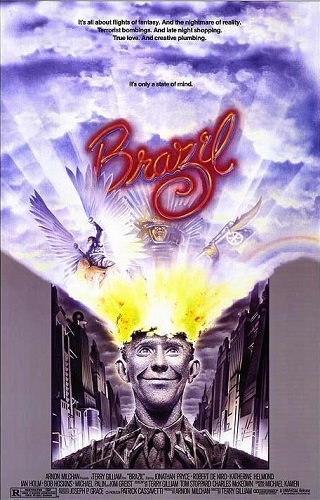
Dark, dystopian and chaotic, Terry Gilliam’s “Brazil” presents a surreal and bureaucratic world where an everyman named Sam Lowry (played by Jonathan Pryce) grapples with a repressive government and a romantic fantasy.
The story is set in a retro-futuristic society filled with excessive bureaucracy, rampant consumerism, and totalitarian government control. Sam Lowry is a low-ranking government worker caught in a mundane job at the Ministry of Information, longing for a more meaningful and adventurous life. He often escapes into vivid daydreams involving a mysterious woman flying through his dreams, representing his desire for freedom and love.
When an administrative error leads to the wrongful arrest and death of an innocent man named Archibald Buttle instead of a suspected terrorist named Harry Tuttle, Sam becomes entangled in a series of events that challenge his compliance with the oppressive system.
Sam becomes infatuated with Jill Layton (played by Kim Greist), a woman resembling his dream girl. He embarks on a quest to rescue her after she mistakenly falls under suspicion by the government for her association with Harry Tuttle (played by Robert De Niro), a renegade air conditioning engineer wanted for his unauthorized repairs.
Throughout the film, bureaucratic absurdity and surrealism blend as Sam navigates a world filled with oppressive regulations, absurd paperwork, and pervasive surveillance. His attempts to save Jill lead him to confront the absurdities and corruption of the totalitarian regime, risking his own safety and sanity in the process.
As Sam delves deeper into the labyrinthine bureaucratic machine to expose the injustices and save Jill, reality becomes increasingly fragmented, blurring the lines between fantasy and the harshness of the dystopian society.
The climax unfolds in a chaotic and nightmarish sequence where Sam’s reality collapses entirely, culminating in a tragic yet ambiguous ending that blurs the boundaries between dreams and reality.
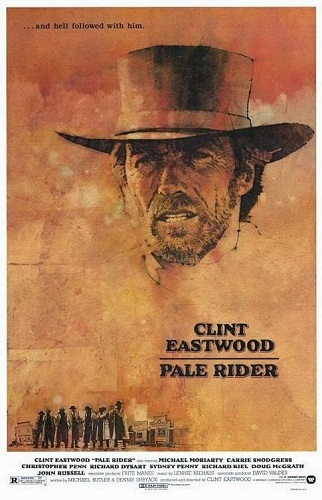
“Pale Rider” is a classic Western directed and starring Clint Eastwood. The film follows the story of a mysterious preacher who rides into a small mining town in the Sierra Nevada Mountains and becomes embroiled in a conflict between struggling gold miners and a powerful landowner.
The story begins with a group of independent gold miners facing oppression from a ruthless mining tycoon, Coy LaHood (Richard Dysart), who aims to force them off their claims and seize their land for his mining operation. Seeking justice and protection, the miners turn to prayer and hope for divine intervention.
In response to their prayers, a nameless Preacher (played by Clint Eastwood) arrives in the town, riding a pale horse. His arrival sparks intrigue and suspicion among the locals due to his enigmatic nature and mysterious past.
The Preacher soon aligns himself with the miners, offering them guidance, protection, and spiritual support. He becomes a symbol of hope and resistance against the tyranny of LaHood and his hired thugs.
As tensions escalate, the conflict between the miners and LaHood’s men intensifies, leading to violent confrontations. The Preacher, using his quick draw and formidable skills, becomes an avenging angel for the oppressed, defending the miners against the encroaching threats.
Simultaneously, the Preacher forms a deep bond with Megan Wheeler (Sydney Penny), a young girl who lives with her mother Sarah (Carrie Snodgress), a widow among the miners. The Preacher’s relationship with Sarah becomes a central theme, as their connection and shared past gradually unfold.
The film builds towards a climactic showdown, where the Preacher faces off against LaHood and his hired guns in a dramatic and action-packed finale. The conflict reaches its peak as the Preacher fights for justice, defending the rights of the miners and confronting the oppressive forces seeking to destroy their livelihoods.
In the end, justice prevails, and the Preacher rides off into the horizon, leaving behind a town liberated from tyranny and oppression. His true identity remains ambiguous, leaving the townsfolk to speculate about his past and the nature of his divine intervention.
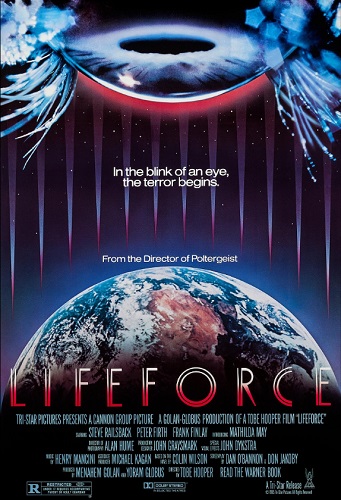
I hummed and hawed about including this one in my Top 5. But ultimately I really enjoyed the film, plus parts of it were shot were I lived at the time (so nice to see the local greengrocers and other stores down the road from me on film captured in time, so I decided Lifeforce would make the final cut ahead of some of the other choices.
“Lifeforce” is a science fiction horror film that weaves a tale of space exploration, vampiric entities, and an apocalyptic threat to humanity directed by Tobe Hooper (Poltergeist; The Texas Chain Saw Massacre).
The story begins when a joint Anglo-American space mission led by the spaceship Churchill discovers a mysterious spacecraft hidden within the coma of Halley’s Comet. Upon boarding the vessel, the crew encounters a haunting scene—eerie bat-like creatures and human-like corpses. Among the bodies lies three naked humanoid beings in suspended animation, one of whom is a strikingly beautiful female alien (played by Mathilda May).
The crew brings the three beings back to Earth for further investigation, unaware that these entities are energy vampires capable of draining life force from humans, leaving them as desiccated husks. Chaos ensues when the creatures awaken, promptly escaping their confinement and leaving a trail of death and destruction at the research facility.
Colonel Tom Carlsen (played by Steve Railsback), the sole survivor of the Churchill, pursues the female alien, who seems to possess an otherworldly allure and a devastatingly seductive power over men. As London falls into chaos due to the spreading vampiric plague, Carlsen teams up with SAS Colonel Colin Caine (played by Peter Firth) and Dr. Leonard Bukovsky (played by Frank Finlay) to hunt down the alien creatures and halt the cataclysmic contagion.
The film progresses into an interstellar journey that reveals the alien beings’ origin and their ominous plan to propagate their species by draining Earth’s life force, leading to the imminent destruction of humanity. Carlsen and his team must race against time to stop the aliens from unleashing a global catastrophe.
The climax takes a cosmic turn as Carlsen confronts the aliens aboard their colossal mothership, engaging in a metaphysical battle that could decide the fate of the world. Sacrifices are made, and an epic struggle ensues, culminating in a spectacular and mind-bending finale that attempts to thwart the aliens’ nefarious plan.
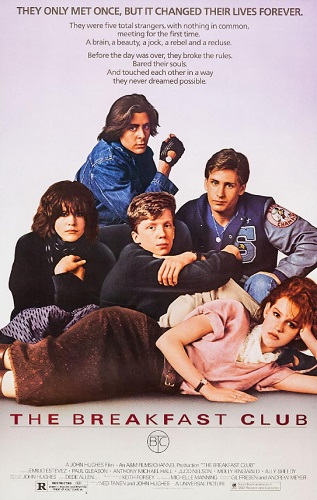
“The Breakfast Club” is my favourite movie by Director John Hughes. It is a seminal coming-of-age film that revolves around five high school students from different social cliques forced to spend a Saturday detention together. Through this shared experience, they confront their differences, break down stereotypes, and form unexpected connections. It was a movie that really struck a nerve to many growing up in the 80’s, plus cemented Simple Minds “Don’t You (Forget About Me)” as a classic track.
The film opens as five teenagers arrive at Shermer High School for Saturday detention. Each character represents a different high school stereotype: the brainy but socially awkward Brian Johnson (Anthony Michael Hall), the rebellious and confrontational John Bender (Judd Nelson), the popular and conceited Claire Standish (Molly Ringwald), the sensitive athlete Andrew Clark (Emilio Estevez), and the introverted outsider Allison Reynolds (Ally Sheedy).
Under the supervision of their strict and authoritarian principal, Mr. Vernon (Paul Gleason), the students are instructed to write an essay about who they think they are. Initially, they remain in their respective social circles, harboring preconceived judgments about each other.
However, as the day progresses, they begin to open up and break down barriers. They engage in conversations, share personal stories, and gradually discover they have more in common than they initially believed. They confide in each other about their struggles, family issues, and societal pressures, realizing that they are all grappling with their own insecurities and facing expectations from their peers and parents.
As they bond, they challenge and confront each other’s perspectives, breaking down stereotypes and societal norms. They experience moments of laughter, camaraderie, and empathy, forming genuine connections that transcend their social labels.
Throughout the day, they engage in various activities, from discussing their fears and aspirations to dancing and forming unlikely friendships. As they begin to understand and empathize with each other’s struggles, they develop a newfound sense of solidarity and mutual respect.
The film concludes with the students leaving detention, having forged a unique bond that transcends the barriers of their high school cliques. They depart with a newfound understanding of themselves and each other, realizing that despite their differences, they are all united by the shared experience of adolescence and the desire to break free from societal expectations.
So the above are my favourites from 1985, but they are certainly not the only good films to have come out that year. Several of the below almost made my list, and would probably be on some of yours. Some of the other movies to come out in 1985 include:
- The Goonies
- The Jewel of the Nile
- Rambo: First Blood Part II
- Rocky IV
- The Color Purple
- Out of Africa
- Witness
- Cocoon
- Commando
- The Jewel of the Nile
- A View to a Kill
- Mad Max Beyond Thunderdome
- Pee-wee’s Big Adventure
- A Room with a View
- Clue
- Desperately Seeking Susan
- Weird Science
- St. Elmo’s Fire
- The Killing Fields
- The Last Dragon

