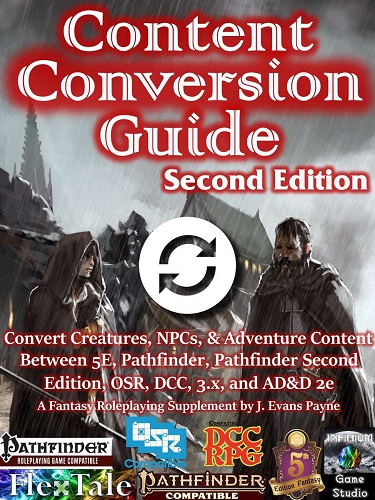
Content Conversion Guide Second Edition (Pathfinder / 5E / P2E / OSR / DCC / d20 3.5 / AD&D 2e)
by Infinium Game Studios
If you’ve ever wanted to take adventure content from one system and use it in another, this book has been designed to be of invaluable help.
With full support for 3.x and AD&D 2e, you can easily convert decades-old campaign material for use with more recent rules systems, or vice versa.
Return to the realms of Greyhawk, Mystara, Planescape, Al-Qadim, Dark Sun, Kara-Tur, Birthright, and even Hollow World, or explore them for the very first time, in the rules system of your choice!
Extend and enhance the options available for settings that have been republished, but much more sparsely than the hundreds of sourcebooks and adventures that are available over the decades for older systems. Ravenloft, Forgotten Realms, Spelljammer, and more: if you liked the material that is available for 5E, you’ll gush at the opportunity to delve into hundreds of sourcebooks that have come before.
Relive, or relish, HUNDREDS of ancient sourcebooks, adventures, and options, in the modern rules system of your choosing.
Take the hundreds of first-party, and thousands of indie, adventures and sourcebooks that have been published for P1E and other older systems, and use them in 5E or another supported system of your choice.
Convert any content, from any of the supported rules systems, into any of the other rules systems.
Only with the Content Conversion Guide: Second Edition.
The Content Conversion Guide (CCG) is a book that walks through a process of converting adventure content amongst seven of the most popular tabletop roleplaying game systems:
Pathfinder First Edition
5E/Fifth Edition
Pathfinder Second Edition
OSR
Dungeon Crawl Classics (DCC)
3.x / d20
AD&D 2e
Some G/DMs convert content on the fly, in their heads, or just “wing it” in the midst of a gaming session… to various levels of success. Others are rules-rigorous, and would pale at the mere possibility of such a by-the-seat-of-their-pants approach to a game that, by its nature, contains hundreds, if not thousands, of pages of structure.
Neither is “wrong” or “right”. Every gaming table has a different calculus for fun, and every G/DM has their own approach, both to the game, to the rules, to the players, and to themselves and their own creativity.
But whether you’re naturally skilled at adapting rules mechanics, or you’re petrified at the mere notion of trying to do so, having a guide can only help things and make more possible.
What is Old, is New Again
There’s lots of reasons why people might want to convert content from one rules system to another. Shocking as it may be, there are entire universes, huge sprawling campaign worlds and hundreds of adventures and realms, that have never been reprinted or reproduced for the modern era of roleplaying. Gone are the days of Dark Sun, Kara-Tur, Birthright, Al-Qadim, and even Hollow World, their loss lamented to varying degrees.
Those of us who grew up exploring these worlds have every reason to wish to return to them again in this century. Those of you who have never experienced the wastes of Athas, the rocky plateaus of Aebrynis, the sanes of Zakhara, or the innards of Mystara have every reason to venture to these strange places. (I will bet that there are some of you who are, no doubt, Googling some of these names at this very moment at their mention.)
Teaching Old Dogs Modern Tricks
Conversely, there’s those of us who still play using older rules systems, and we have every reason to want to use the enormous trove of official and independently-published third-party content that has been produced more recently. The notion of, for example, running Waterdeep: Dragon Heist using AD&D Second Edition rules and rigor is nothing short of thrilling.
What’s Changed in the Second Edition of This Book
- New Systems: This is the biggest update: Conversion to and from the 3.x / d20 era of the World’s Most Popular Roleplaying Game received some love in the first edition of the book, but the Second Edition supports it fully. And although some brave souls used the OSR conversions from the first edition book to convert to and from AD&D 2e, this second edition of the CCG explicitly supports it as a separate concept. Each and every conversion topic, from hit dice to alignment, from senses to spellcasting, has been fully embraced and described for both of these rules systems. Revisions & Errata: No part of this book has survived unscathed from the First Edition. Each and every modifier, mapping, table, suggestion, and justification has been re-evaluated in the nearly five years since its inception.
- Improved Formatting & Editing: Everything about the formatting of the book has changed. Fonts and colors have been updated to make the text more accessible, the parchment backdrop has been removed to improve readability, and nearly every table and tool has been reformatted to make it as quick and easy as possible to understand, and to use.
- Complete Feat Mappings: This topic was covered extensively in the first edition, but the second edition is complete. Each and every one of the 300+ feats in Pathfinder Second Edition has been mapped, as has each of the 230+ non-weapon proficiencies in AD&D 2e for Wizards, Warriors, Rogues, Priests, and General proficiencies.
- New / Clearer Sections: It’s a small thing, but creature Types, Sizes, and Alignments have been separated out and expanded. A new distinct section dedicated to Speed and Movement has been added as well.
- Actions and Combat Clarity: This topic has been greatly expanded in this edition, explicitly mapping action types across systems and discussing and mapping a huge array of common combat actions.
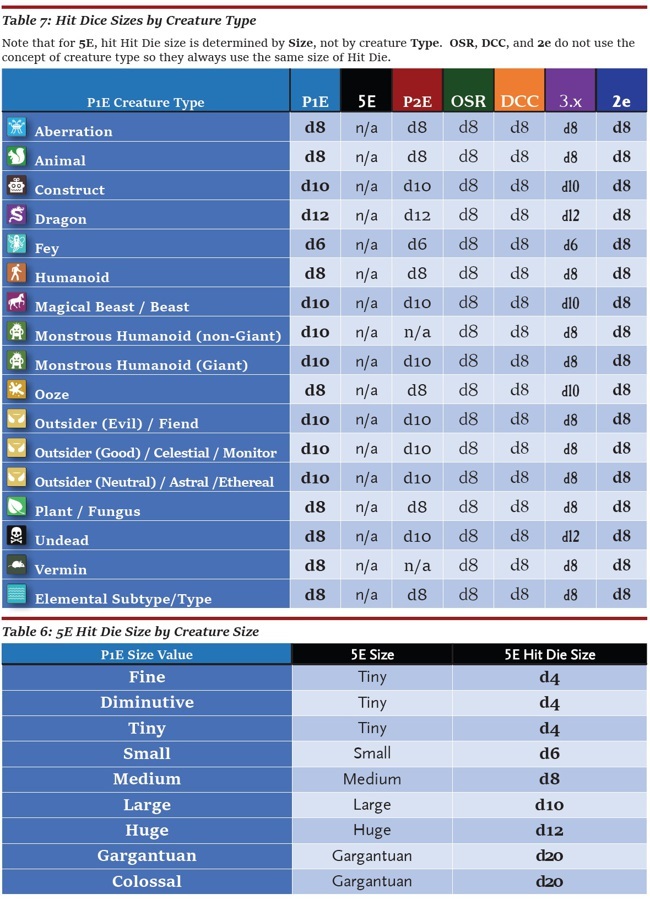
- Hit Dice and HP Improvements: This section has been extensively overhauled, with refined and updated conversion tables for Hit Dice and Hit Points.
- Expanded Energy and Damage Type Conversions: These topics have much clearer, and more complete, conversion tables, including a 5E-specific iteration.
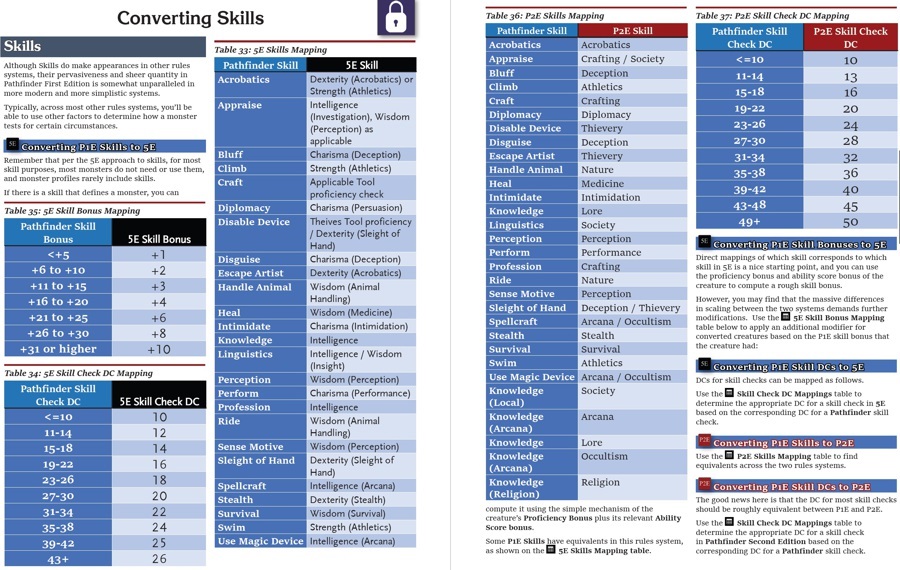
- Complete Skills Mapping: This was a topic covered very well in the first edition, but there were some minor misses. The mappings should now be complete and reflect all of, for example, P2E skills.
- Streamlined Book: The first edition contained hundreds of pages of sample monsters from the supported rules systems. While this was intended as a useful example of how to Quad creatures and to convert them across rules systems, it mainly just served to balloon the size of the book, which was frustrating for those who bought a hardcopy and wanted an easy-to-spread-out book at the gaming table. This content was also duplicative of what’s available in the Aquilae: Bestiary of the Realm books, which many first edition CCG owners also possessed. This content has been removed from the main book; it’s still available as a free PDF download for those who own this second edition.
- Includes the Mapping Inventory XLS: In the first edition of the book, the Content Conversion Mapping Inventory was a separate product, available for those who wanted a Microsoft Excel rendition of all of the most valuable tables and tools in the book, as well as an exhaustive mapping of the 4,800+ creature abilities, 100+ poisons, 160+ weapons, and 530+ spells whose mappings were also included. In this second edition, you get this immensely valuable tool for free.
- Get to the Good Stuff: Another small thing, but I moved the How to Quad topic to the end of the book and put the How to Convert stuff right up front. Most people who used the first edition of this book want to convert, rather than quad, and considered the latter a separate topic.
What’s Included?
- Part 1 is How to Convert: The guts of the book. A topic-by-topic, step-by-step rules to take each statistic, and how to adapt it into other formats so the resulting monster “makes sense” and is usable.
- Part 2 is the Conversion Mapping Inventory: Complete lists for Spells, Feats, Weapons, Skills, and Poisons, with converted analogues for each in other formats as appropriate. Some of these do not have a good analogue in other rules systems, but for the majority, there will be entires.
- Also Included for FREE: A separate Excel-based product contains the complete Conversion Mapping Inventory for more than 4,800 monster special abilities and attacks; it would take more than 3,000 pages to lay all of that out in book form so it’s not feasible!
- Part 3 is How to Quad: Rules for taking a monster, NPC, trap, etc. in a single statblock, and adapting it into three additional statblocks, so as to support a wide range of PC levels and difficulties.
- Part 4 is Creating New Quadded Monsters: Guidelines and rules for how to take an existing monster as a starting point, and to expand its abilities and to create Quadded Statblocks for it so it’s usable for any PC group

What’s Covered?
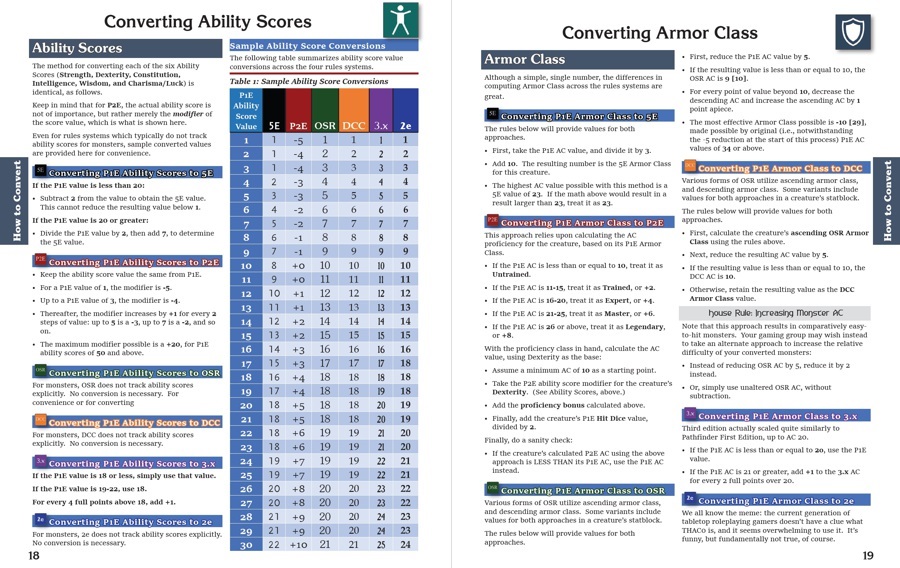
Each of these topics contains discussion, heuristics, a step-by-step walk-through, and one or more mapping tables that make it easy to convert between the supported SEVEN rules systems.
- Ability Scores
- Armor Class
- Hit Dice & Hit Points
- Speed & Movement
- Creature Size
- Creature Type
- Alignment
- Resistances, Vulnerabilities, & Immunities / Special Defenses
- Ability Score Damage rules extensions for systems that don’t natively support it
- Actions
- Common Combat Actions
- Senses
- Languages
- Challenge Rating
- Feats
- Skills
- Special Abilities
- Difficulty Class (including alternate rules approach for systems that don’t use DC at all)
- Spellcasting
- Saving Throws
- Caster Level
- Obstacles
- Traps
- Afflictions (poisons, diseases, etc.)
Onward!

Content Conversion Guide Second Edition (Pathfinder / 5E / P2E / OSR / DCC / d20 3.5 / AD&D 2e) is available through DriveThruRPG in PDF.
Please note: The links in the post above are “affiliate links”. This means if you click on the link and purchase the item the author of this post will receive an affiliate commission.
 Voices From The Pulpit