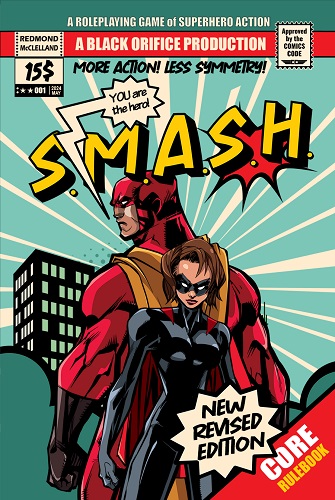
S.M.A.S.H. Revised Core Rulebook
by The Black Orifice
S.M.A.S.H. is the latest game from the creative minds that brought you ENnie-nominated Etherscope. Bringing the concept of asymmetrical games design to the superhero genre, S.M.A.S.H. is a game where each character has its own unique rules and systems, and every hero is genuinely super.
S.M.A.S.H. is a paradigm shift in superhero roleplaying games, bringing the concept of asymmetrical gaming to the genre. In asymmetrical gaming, each character interacts with the mechanics of the game in fundamental different ways. Let’s have a look at how this works in S.M.A.S.H.:
What makes a hero?
The first key component to the game is the idea of splitting up what makes up a superhero into two main aspects: a Power Source and an Archetype. Whilst the archetype was possibly the most obvious option, basically covering what the superhero does, by separating that from how they get their powers – their power source – S.M.A.S.H. is able to reduce the number of archetypes needed. For example, a power suit hero like Iron Man, who basically flies around blasting stuff, could be a Blaster in the same way as the Human Torch, who also flies around blasting stuff. This method also maximises the total number of options by multiplying out the different combinations. With eight archetypes and eleven different power source options, there are a total of eighty eight different combinations for building characters. There’s also a third, somewhat lesser, building block to your character: your alter ego, which determines your skills and what you can do outside of your superpowered abilities.
Another key concept for all characters is Stats. S.M.A.S.H., like many roleplaying games, has stats that are used to determine your character’s basic capabilities: Defence (DEF), Power (POW) and Skill (SKL). Defence determines your defensive capabilities, whether it represents agility or toughness, Power represents the strength of your superpowers, and Skill is used to both determine your ability to use different skills, but also highlighting the difference between those heroes who focused on the skill of how they apply their powers rather than the raw power they wielded. Think about the difference between Captain America and Superman.
Let’s have a look at each of these areas in more detail:
Alter Egos
The idea of an alter ego playing an important part in your character build comes out of the “big picture” of how the game works. The superhero stuff is largely something you only use in fights, but most of the actual roleplaying would come out of the bits between the fights, where your super powers matter little.
The mechanics for alter egos are super-(if you’ll excuse the pun)-simple, so that they don’t get in the way of roleplaying. The core idea here is that you want to very rarely actually want to require the use of a skill. So what do you need to use skills for? There are basically two main ways in which skills can be used: to discover the clues that led you to uncovering the supervillain’s nefarious schemes, and to overcome some of the obstacles that get put in your way. As such, the clues are largely focused on the different ways in which you might discover clues – things like interrogating people, searching an area, following tracks or performing some science experiment. Each archetype basically gets a different number of these skills, at slightly different values, and can pick from slightly different lists.
That wasn’t quite the end of the story, though, because asymmetry is involved at every stage of the game: each alter ego also has its own special rule, focused on collecting clues, but managing it in a very different way. Some alter egos also have different formulas for calculating their levels in each skill, adding further diversity.
Building a Superhero
Power Sources and Archetypes were designed pretty much together. Whilst splitting these two aspects up makes for a good choice in a lot of ways, it creates a bit of a design bottleneck when it comes to asymmetry – there needs to be a standard interface that the power source and archetype both connect to, or it wouldn’t work. That interface was Power Points. Basically, your Power Source determines how many power points you get, and how regularly they regenerate, and your archetype tells you how you can spend these points to achieve your desired mechanical impact on the game. Given this, each archetype and power source needs to be truly different to really make the asymmetry of the game “sing”.
Let’s start by having a quick look at power sources, then we’ll come back to archetypes…
Power Sources
Power sources are a fairly simple beast. It only really covers factors, mechanically speaking: how many power points did you get, and how quickly do you recover them. Add in a few special rules where needed and the job is done. Let’s have a quick look at some of the key ones:
- Alphabetically superior is Absorption, used for those heroes who power themselves up from being attacked. They start with only a small number of points, but have the ability to generate them as they take damage.
- Next up is “Blessing”. This represents those heroes who had a fairly consistent supply of power, but had the ability to have their powers turned off, such as with Superman and Kryptonite. Blessing has a moderate power supply that refreshes every turn.
- Innate, used for characters like mutants, ignore Power Points entirely, and use low-level powers for free. However, if they want to use big effects they will need to exert themselves, essentially meaning they damage themselves to do it.
- At the other end of the spectrum comes the Summoners, who can hold a large amount of power, but can only refresh that power when they take an action to summon more power points.
- Next comes the sort of heroes who aren’t actually superpowered – Batman, Iron Man and the like. These will basically fall into one of three categories: power suits, gadgets and those who are trained to replicate superpowers through a special technique (like a spellcaster, for example). Power suits gain a power source that refreshes each turn, but can be reduced as your suit got damaged, gadgeteers have to pre-pay for their powers in gadgets, and “technique” users needed to make a dice roll to see if their power could successfully go off.
- Finally, there’s the transformation for charaers like the hulk that metamorpohsise into a powered-up form. They get to have two different stat lines, for their human and superpowered form, but also choose another power source to determine their power points from Absoption, Blessing, Innate or Summoning. However, their power level is somewhat limited to compensate for their better stats in superpowered form.
Hero Archetypes
For combat to work smoothly, the archetypes need a standard interface for how they interact with each other. This comes down to an initiative for determining turn order, Hit Points and damage, and a handful of condition effects to represent the different ways in which people interact with each other. The first two of these are handled by a trio of calculated stats: Initiative (INIT), Hit Points (HP) and basic attack (ATK). As S.M.A.S.H. is all about asymmetry, these stats are calculated differently for each archetype. This allows characters to focus on the core stats that were most applicable to that archetype. Bricks, for example, will be better with a high Defence, whilst Blasters will benefit from a high Power stat and Martial Artists from a high Skill.
As S.M.A.S.H. uses a short list of archetypes to cover a vast array of superhero concepts, each needs a host of options to pick from, so that you can create a range of characters from a single archetype. Each archetype provides a selection of Power Moves, which make up the main mechanical block of superpower power effect, and then each of these can be assigned Upgrades. The Asymmetry comes not only from what these powers actually do, but also from how each archetype would get to select their power moves and upgrades. Each archetype also has its own special rules that change a variety of things about the archetype’s approach to the game.
Let’s have a look through each archetype to see how we achieved this asymmetry:
- Blasters: Blasters gain a special rule that sees them rolling dice for damage. Their calculated stats favour Power above all others. Their power moves tend to have a variable power point cost, and come with a scaling effect as a result. Every blaster gains the Blast power move, and then they can choose from other powers and upgrades, being able to apply any known upgrade without it affecting the cost.
- Brick: Bricks have special rules that allow them to respond to enemies, moving and getting stronger as enemies attack them, and soaking damage for the team. Their calculated stats favour Defence, and to a lesser extent, Power. Bricks get to choose upgrades for their power moves without costing them choices, but instead it increases the cost to use that power.
- Controller: Controllers’ powers work by controlling objects or creatures, called Thralls, and getting them to do their bidding. Their calculated stats favour Power and Skill over Defence. As with Blasters, Controllers all get the Summon Thrall power move, but this is actually the only power move the class has. Instead they have a large suite of upgrades for this power to choose from that modify the strength and utility of their Thralls.
- Every Hero: The Every Hero is a themed superhero – Spiderman is a great example. When creating an every hero you choose three keywords to define your theme, which then determine what powers you can buy. They prefer a balance of stats in their calculated stats. Every heroes buy power moves and upgrades in a similar manner to Bricks (upgrades don’t cost them options but increase the power point cost), but in addition each power move has a list of keywords, and the more keyword matches you have, the fewer of your choices it will cost you to learn that power move. As a result they have probably the broadest range of powers as an archetype, but lacking the right keywords will reduce this list for each individual build. Every hero is by far the most versatile of the archetypes at character creation.
- Martial Artist: The martial artist’s special rules all revolve around how their powers work. Every martial artist power move is a reaction to something else, often another of your power moves, allowing them to chain together combos of power effects. As a result they can choose a special combat Stance, which affects some of their power moves, and a rule that determines how many moves they can chain together at a time. Their calculated stats heavily favour Skill.
- Mimic: Mimics copy the powers from other superheroes. They have a special rule that determines who they can copy, and then they can choose their powers each round, rather than choosing them at character creation. The archetype of the hero or villain that they are mimicking, however, restricts what powers they are able to use in the same round. That said, they do have a special rule called “Sticky Powers” that allows them to have powers that they always have access to, a bit like Rogue’s super strength and flight abilities.
- Shapeshifters: The shapeshifter archetype was basically designed to combine together two common superhero archetypes: those that transform between different forms, like Ant Man and Beast Boy, and those who stretch and warp their body to achieve different effects, like Mr Fantastic. As a result, one of their special rules, Mastered Forms, allows them to pre-pick a collection of different powers and activate them together. Their calculated stats prefer Power and Defence over Skill. When a Shapeshifter learns a new power move, they automatically learn all the upgrades associated with it. Each power move has a variable cost and scaling effect (similar to Blasters), but they get to choose to apply a number of upgrades based on the points that they spent on the effect itself.
- Speedsters: The Speedster’s special rule allows them to activate multiple times in the round, in reaction to enemy activations. This allows the speedster to keep moving and attacking throughout the round. Their calculated stats favour Power and, to a lesser extent, skill. Speedsters, like Shapeshifters, learn any upgrades with they learn a new power move, but, unlike shapeshifters, they have to spend extra power points to use them, and are limited to using one per activation – their power comes from being able to act several times, so their powers are individually a bit weaker than other archetypes.
Hopefully now I’ve given you a flavour of how the game works and whet your appetite for this amazing game.
New revised edition
This new revised edition has been created to both respond to some criticism of the original edition in terms of clarity and the use of AI art, and to include a bunch of new rules that we’ve developed as we’ve been playing it regularly over the last year. For those of you who already have the original, here’s what’s new:
- Improved clarity to the core rules and terminology used in the game
- Removal or all AI-generated art
- A bunch of new character options, including new powers, upgrades, skills, story hooks, and expanded options within the archetype special rules.
- The addition of the “Power Splash” rule to allow characters to add a dash of out-of-archetype flavour to their hero build
S.M.A.S.H. Revised Core Rulebook is available through DriveThruRPG in Print and PDF.
Please note: The links in the post above are “affiliate links”. This means if you click on the link and purchase the item the author of this post will receive an affiliate commission.
 Voices From The Pulpit