I’m a massive movie fan. I have been ever since I was a kid. Trips to the cinema were wondrous events… not least because back in the 80’s we still had usherettes who sold chocolate and ice creams in the screen. they also sold cigarettes – and people could smoke in the screen – so I’m gald somethings have changed since then.
Over the next few weeks I’m going to be looking back over some of my favourite movies which were released each year, from 1980 until more recently. These aren’t films that I neccessarily saw in that year (I didn’t see The Long Good Friday when I was 8 for instance!) but are what I consider my favourite movies released in each given year.
Last week we travelled to 1982, which was overflowing with great movies to choose from – with hard decisions to made on the final Top 5 choice. This year we roll forward to see what 1983 has to offer us.
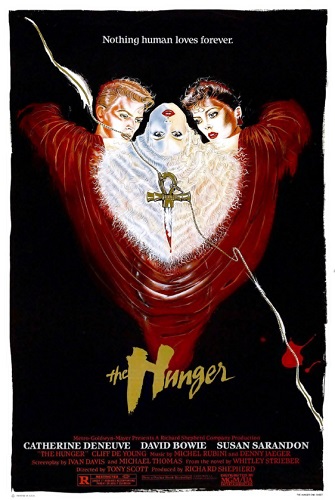
“The Hunger,” is one of my favourite vampire movies. Directed by Tony Scott, and starring David Bowie, Cathering Deneuve and Susan Sarandon, it is a stylish and atmospheric vampire film whose story revolves around a love triangle involving elegant vampires and their struggle with eternal life.
The film opens with an affluent and enigmatic vampire couple, Miriam Blaylock (Deneuve) and John (Bowie), residing in their opulent New York City townhouse. They live a lavish and seemingly eternal existence, sustained by Miriam’s promise of everlasting life to her companions.
However, their immortal world starts to unravel as John rapidly ages and begins to experience the horrifying consequences of Miriam’s false promise. Desperate and distraught, John seeks medical help, but no cure can halt his rapid degeneration.
Dr. Sarah Roberts (played by Susan Sarandon), a specialist in premature aging, becomes entangled in this mysterious case when she encounters John at the hospital. As she delves deeper into the investigation, Sarah discovers the truth about Miriam and her vampiric nature. Sarah’s research leads her to Miriam’s townhouse, where she confronts the unsettling reality of eternal life and the horror that accompanies it.
Miriam, seeing potential in Sarah, attempts to seduce her into her immortal world. Sarah initially resists, but she finds herself drawn into a complex and sensual relationship with Miriam.
Throughout the film, Tony Scott creates an ambiance of eerie sensuality and gothic beauty, coupled with a haunting score by Michel Rubini and Denny Jaeger, complete with the fantastic “Bela Lugosi’s Dead” track from Bauhaus. The movie showcased what at the time was an unconventional take on the vampire mythos, exploring themes of love, desire, mortality, and the longing for eternal life.
The climax of the film unveils a twist in Miriam’s nature and intentions, revealing her cycle of love, death, and rebirth. The conclusion brings a chilling revelation about Sarah’s fate and the cycle of vampirism.

Brian De Palma’s “Scarface” is a classic gangster movie.
The film opens with Tony Montana, played by Al Pacino, arriving in Miami as a Cuban refugee, seeking the American dream. Eager to climb the criminal ladder, Tony quickly establishes himself by working for drug lord Frank Lopez (played by Robert Loggia) and proves his brutality and determination in the criminal underworld.
Tony’s ascent to power is rapid and ruthless. He seizes control of the drug trade, displaying a relentless pursuit of wealth and status. His charisma, aggression, and refusal to compromise his ambitions make him both feared and respected within the criminal fraternity.
Tony’s professional success is coupled with personal indulgence. He lavishes in excess, acquiring wealth, a lavish mansion, and indulging in a passionate yet tumultuous relationship with Elvira Hancock (played by Michelle Pfeiffer), Frank Lopez’s girlfriend.
As Tony amasses power, he becomes increasingly paranoid and megalomaniacal, alienating those closest to him and betraying his allies. His greed and volatility lead to a series of violent confrontations and betrayals within his organization.
The film culminates in a catastrophic downfall for Tony Montana. His violent tendencies and thirst for power result in numerous enemies seeking retribution. In a climactic and iconic scene, Tony, fueled by cocaine and armed to the teeth, faces off against an onslaught of attackers in his mansion, resulting in a violent and tragic demise.
The film’s unapologetic violence, Pacino’s compelling performance, and De Palma’s stylized direction have cemented its status as a cult classic in the crime genre, leaving an indelible mark on popular culture. The film’s iconic quotes and imagery continue to resonate in the cinematic landscape, making it a defining piece of ’80s cinema.

Set in a mystical world where ancient warriors, sorcery, and supernatural forces collide, “Zu Warriors from the Magic Mountain” is a Hong Kong fantasy film directed by Tsui Hark.
The story revolves around a young soldier, Ti Ming-Chi (played by Yuen Biao), who becomes embroiled in a cosmic battle between good and evil. He discovers a hidden world when he encounters two powerful warriors, Ting Yin (played by Adam Cheng) and Hsiao Yu (played by Brigitte Lin), battling malevolent forces threatening humanity.
The film introduces viewers to the concept of the Magic Mountain, a sacred place where ancient warriors harness mystical powers to protect the world from demonic entities. Ti Ming-Chi joins forces with the warriors and learns about the powers of Taoist magic, which enables them to combat the dark forces seeking to unleash chaos and destruction.
As the story unfolds, the warriors confront a formidable adversary, the Blood Demon, who poses a grave threat to the balance between good and evil. The battle intensifies as they strive to prevent the Blood Demon from obtaining ultimate power and plunging the world into darkness.
I first saw Zu Warriors from the Magic Mountain late one evening on TV, sometime in late 80’s I think. I loved it instantly and it opened the door to a lot of Hong Kong cinema for me at the time. It remains a cult classic, influencing the wuxia genre with its innovative visuals and fantastical storytelling, captivating audiences with its imaginative depiction of ancient battles and the cosmic struggle between good and evil.

“Flashdance” became a cultural phenomenon when it was released, leaving an indelible mark on popular culture, having a fantastic soundtrack, captivating dance sequences, and Jennifer Beals’ iconic portrayal of a determined and talented young woman striving to achieve her aspirations in the world of dance.
Directed by Adrian Lyne “Flashdance” is a romantic drama that centers around the life of Alex Owens (Jennifer Beals), a young woman who works as a welder in a Pittsburgh steel mill by day and dreams of becoming a professional dancer by night.
Alex possesses a fierce passion for dance and aspires to gain admission to a prestigious dance academy. In her free time, she trains vigorously at a local dance bar, Mawby’s, where she mesmerizes the audience with her electrifying dance performances.
While navigating her challenging dual life as a welder and aspiring dancer, Alex becomes romantically involved with her boss at the steel mill, Nick Hurley (played by Michael Nouri). Their relationship initially faces obstacles due to their differing backgrounds and social statuses, but they share a deep connection and a mutual respect for each other’s ambitions.
As Alex prepares for her audition at the dance academy, she faces personal doubts and struggles with self-confidence. The film features iconic dance sequences, most notably the audition scene where Alex performs an exuberant and memorable dance routine set to Irene Cara’s hit song “What a Feeling.” This scene has become iconic in popular culture, symbolizing Alex’s passion, determination, and pursuit of her dreams.
“Flashdance” explores themes of ambition, perseverance, and the pursuit of one’s aspirations despite facing adversity. It captures the essence of the 1980s with its vibrant soundtrack, energetic dance sequences, and a portrayal of a young woman striving to break free from societal norms to follow her passion.
The film concludes with Alex’s triumphant acceptance into the dance academy, symbolizing the fulfillment of her dreams and the beginning of a new chapter in her life.
Flashdance was one of many popular dance movies in the 80’s, with Fame (1980), Footloose (1984) and Dirty Dancing (1987) all doing phenomenally well at the box office.
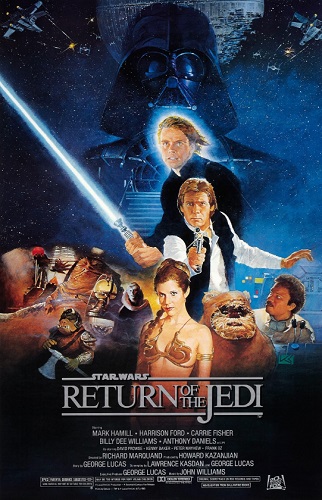
A top movies list of 1983 would never be anything without the third installment of the mighty Star Wars Trilogy.
“Return of the Jedi” is the final installment of the original Star Wars trilogy, directed by Richard Marquand. The film continues the epic saga of the Rebel Alliance’s struggle against the tyrannical Galactic Empire, led by Darth Vader and Emperor Palpatine.
The story picks up with Han Solo (Harrison Ford) imprisoned by the vile gangster Jabba the Hutt, and Princess Leia (Carrie Fisher) executing a daring plan that involves rescuing Han from Jabba’s Tatooine palace.
Meanwhile, Luke continues his Jedi training under the guidance of Master Yoda. However, Yoda’s health deteriorates, and he imparts his final wisdom to Luke before passing away, revealing that there is another Skywalker – his twin sister, Leia.
The Alliance learns of the Empire’s construction of a new Death Star, a battle station capable of destroying entire planets. As the Alliance plans to launch an attack to destroy this new threat, Luke confronts Vader and the Emperor, seeking to bring his father back to the light side of the Force.
The film builds up to an epic battle between the Rebel Alliance’s fleet and the Imperial forces above the forest moon of Endor. Simultaneously, on Endor’s surface, a team led by Han Solo, Leia, Chewbacca, and the Ewoks, the indigenous creatures of the moon, work to disable the shield generator protecting the Death Star.
Luke confronts Vader and the Emperor on the Death Star, hoping to redeem his father from the dark side. The climactic lightsaber duel between father and son reaches its peak as the Emperor urges Luke to give in to his anger and strike down Vader.
In a pivotal moment, Luke resists the temptation of the dark side and refuses to strike Vader down. The Emperor, seeing an opportunity, attempts to destroy Luke, but Vader, conflicted by the love for his son, ultimately redeems himself by sacrificing his own life to save Luke, throwing the Emperor into the Death Star’s reactor shaft.
With the shield down, the Rebel fleet seizes the opportunity and destroys the Death Star, bringing an end to the Emperor’s tyranny and marking a victory for the Rebel Alliance.
“Return of the Jedi” culminates with a celebratory reunion as the galaxy celebrates the fall of the Empire and the triumph of good over evil. This was to be the last of the Star Wars movies for 16 years, until the franchise was resurrected with the series of prequels starting with Star Wars: Episode 1 – The Phantom Menace in 1999.
The above is my Top 5, but there were loads of movies to come out in 1983, a number of which could have made it in to the list. Some of the other films released in 1983 include:
- Christine
- Krull
- WarGames
- Trading Places
- Risky Business
- National Lampoon’s Vacation
- Never Say Never Again
- Octopussy
- Monty Python’s The Meaning of Life
- Blue Thunder
- The Dead Zone
- Educating Rita
- Superman III
- The Man With Two Brains
- A Christmas Story
 Voices From The Pulpit