I’m a massive movie fan. I have been ever since I was a kid. Trips to the cinema were wondrous events… not least because back in the 80’s we still had usherettes who sold chocolate and ice creams in the screen. they also sold cigarettes – and people could smoke in the screen – so I’m gald somethings have changed since then.
Over the next few weeks I’m going to be looking back over some of my favourite movies which were released each year, from 1980 until more recently. These aren’t films that I neccessarily saw in that year (I didn’t see The Long Good Friday when I was 8 for instance!) but are what I consider my favourite movies released in each given year.
Last time we took a look at my favourite movies from 1981, so this time we’re popping down to the local theatre to see what 1982 offered us… and it’s overflowing with classics!
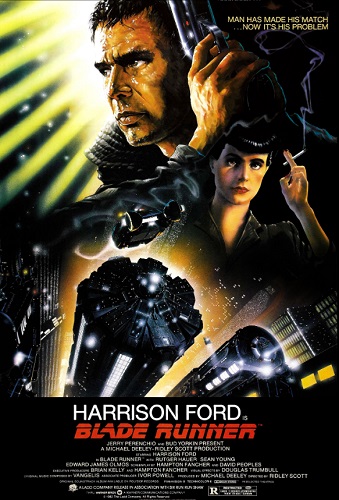
Where to start with this embarrassment of riches from 1982. Hmmm…. maybe a trip to the Los Angeles of 2019 with Ridley Scott’s classic “Blade Runner”.
“Blade Runner” is a science fiction neo-noir film set in a dystopian future, based on Philip K. Dick’s novel “Do Androids Dream of Electric Sheep?” The story is set in a rainy, futuristic Los Angeles in 2019, where genetically engineered beings known as replicants, virtually indistinguishable from humans, are used for dangerous off-world labor.
The plot follows Rick Deckard (played by Harrison Ford) a specialized law enforcement officer called a Blade Runner who is tasked with hunting down and ‘retiring’ rogue replicants. He is reluctantly drawn into tracking down a group of highly advanced Nexus-6 replicants who have illegally returned to Earth, seeking to extend their artificially shortened lifespans.
The film explores philosophical themes of what it means to be human, posing questions about the nature of existence, memory, and empathy. Central to the narrative is the emotional development between Deckard and Rachael (played by Sean Young), a replicant who believes herself to be human due to implanted memories.
This visually stunning film presents a cyberpunk aesthetic with its dark, rain-soaked cityscapes and industrial landscapes, underscored by a mesmerizing score by Vangelis. It culminates in a poignant climax where Deckard confronts the leader of the replicant group, Roy Batty (portrayed by Rutger Hauer), in a battle that challenges Deckard’s perception of what it means to be truly alive. It also leads to Hauer’s most famous lines, which he partially improvised whilst filming the scene… “I’ve seen things you people wouldn’t believe. Attack ships on fire off the shoulder of Orion. I watched C-beams glitter in the dark near the Tannhauser gate. All those moments will be lost in time… like tears in rain… Time to die.”
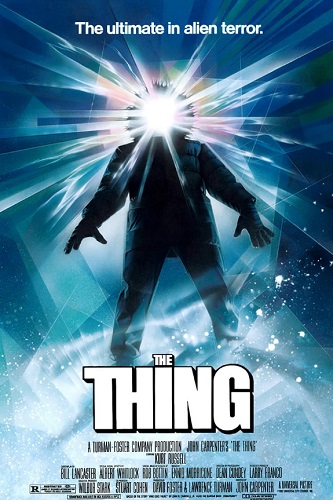
“The Thing,” directed by John Carpente, is a science fiction horror film that unfolds in the desolate Antarctic. The story revolves around a group of researchers at an isolated American research station who encounter a shape-shifting extraterrestrial organism.
As the team investigates a nearby Norwegian station, they discover the remains of a creature that is seemingly of extraterrestrial origin. They bring back the partially destroyed remains to their own base, unknowingly awakening a shape-shifting alien capable of imitating any living organism it comes into contact with.
Paranoia and fear escalate as the group realizes that anyone among them could be the Thing, leading to distrust and terror. The creature’s ability to mimic humans and animals perfectly adds to the tension, leading to an atmosphere of suspense and dread.
The film is a psychological thriller as the group’s dynamics disintegrate, with members turning against one another. They become isolated, suspicious, and unable to trust anyone, unsure of who is truly human and who is an imitation.
The movie reaches a terrifying climax as the survivors face the grim reality of their situation and are forced to confront the Thing in a suspenseful battle for survival, not only against the alien but also against the frigid, unforgiving environment.
Strangely, like Blade Runner, the film was critically panned by many upon its release and did not do well at the box office. Thankfully both films found success through the video market and are now considered classics and masterclasses of film making.
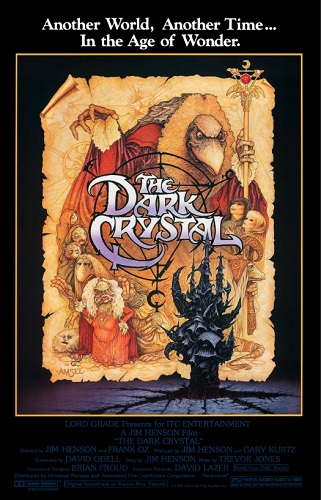
“The Dark Crystal” is a fantasy film co-directed by Jim Henson and Frank Oz. Set in the mystical world of Thra, where an ancient prophecy holds the key to restoring balance. The story revolves around the young Gelfling named Jen, one of the last of his kind, who is sent on a quest by the wise Mystic, the Master of the Mystics, to heal the Dark Crystal.
The Dark Crystal, an artifact shattered by the evil Skeksis, threatens the harmony of Thra. Jen’s journey leads him through fantastical landscapes, encountering various creatures and challenges along the way – such as Aughra in her wondrous observatory. Jen discovers the truth about his heritage, learning that he is destined to fulfill the prophecy and restore the crystal to its former glory.
As Jen confronts the malevolent Skeksis and their dark intentions, he encounters Kira, another surviving Gelfling, and together, they strive to overcome the malevolent forces that seek to perpetuate chaos and darkness.
The film has such a richly detailed world, which has subsequently been explored in comics, some great making of guides (check out Brian Froud’s “The World of The Dark Crystal”), and the Netflix TV series which acts as a prelude to the movies set a thousand years before the events of the movie.
Puppetry at it’s finest.
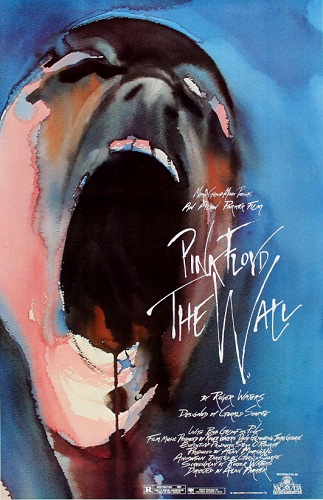
Alan Parker directed “Pink Floyd: The Wall,” a fantastic adaptation of Pink Floyd’s album “The Wall.” The movie follows the troubled life of a rock star named Pink, played by Bob Geldof, who spirals into a mental breakdown and self-imposed isolation, constructed metaphorically as a wall around him.
Through a series of surreal, symbolic, and often disturbing vignettes, the film delves into Pink’s traumatic past, exploring themes of alienation, war, the music industry, and societal norms. The narrative weaves between Pink’s experiences as a rock star, his childhood traumas, and the construction of an emotional and metaphorical wall that isolates him from the world.
The film is a visual spectacle, featuring stunning animation sequences, striking imagery, and potent symbolism. As Pink’s mental state deteriorates, he becomes increasingly detached from reality and descends into a delusional state, culminating in him becoming a fascist dictator who starts targetting queers, blacks, Jews, or anyone that looks at him funny.
The film is a masterpiece, and we actually studied it in my film class at school in the late 80’s. It’s a movie that, whilst dark and disturbing, I can watch and rewatch. I love the album, and the songs appear throughout the film to great effect. I was lucky enough to see Roger Waters perform the entirety of “The Wall” at Wembley Stadium in 2013 and it was easily in my top handful of concerts I’ve ever been to.
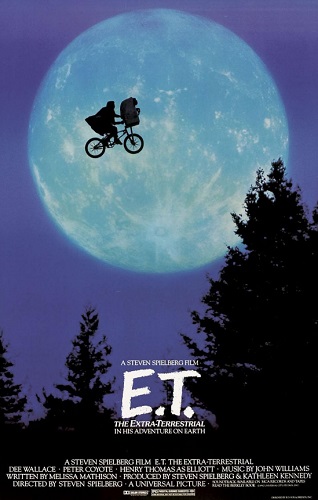
“E.T. Phone Home”
Steven Spielberg’s “E.T. the Extra-Terrestrial” is a heartwarming and iconic science fiction film centered around a young boy named Elliott, who discovers and befriends a gentle alien botanist stranded on Earth.
The alien, affectionately named E.T., forms a strong emotional bond with Elliott and his siblings, gradually revealing his otherworldly abilities and a desire to return home. Meanwhile, Elliott and E.T. share a psychic connection, allowing them to experience each other’s feelings and thoughts.
The film encapsulates a story of friendship, trust, and the universal desire to belong, despite differences in species and worlds. As Elliott and his friends attempt to keep E.T. hidden and help him build a device to contact his home planet, the government is trying to track the alien down.
As E.T.’s health deteriorates on Earth, his need to return home becomes urgent. Elliott, due to his connection with E.T. also starts to experience the same symptoms. With the help of his friends, Elliott evades the authorities and helps E.T. reach his spaceship. In a touching farewell, E.T. bids farewell to Elliott and returns to his home planet.
Apart from everything else in the movie, it was also the first time that I saw Dungeons & Dragons (or atleast a variation of it) on screen, as Elliot’s older brother Michael is playing it with friends at the start of the movie.
1982 was really a great year for films. The above is my Top 5, but films such as Poltergeist woul have made the list in some other years, but the competition this year was just so strong. Some of the other films released in 1982 include:
- Poltergeist
- Star Trek II: The Wrath of Khan
- Tootsie
- Gandhi
- Tron
- The Secret of NIMH
- Annie
- Rocky III
- Conan the Barbarian
- Rambo : First Blood
- Cat People
- An Officer and a Gentleman
- The Entity
- The Best Little Whorehouse in Texas
- The Plague Dogs
 Voices From The Pulpit